
Monday, 16 March 2009
Aussie weakens against the pound
The Australian dollar remained in narrow ranges against sterling over the weekend, as rises in regional stock markets saw investors start to consider taking on riskier assets again. However, the pound remained weighed down by the BoE's continuing programme of quantitative easing. The central bank announced details to purchase another 5 billion pounds of UK Gilts. Little major domestic data is due out of either country today, so direction is likely to come from broader market movements as well as corporate news.


Kiwi dollar posts gains
The New Zealand dollar made small gains over the weekend, underpinned by increased demand for higher yielding currencies on the back of solid gains from equity markets. The kiwi also gained strength after the Reserve Bank of New Zealand signalled that it was near the end of its easing cycle.
Friday, 27 February 2009
Sterling headed for weekly loss against euro
The pound rallied against the single currency yesterday and reversed some of the previous day’s losses, as equity markets rose on the back of the government’s plan to insure banks’ toxic assets. The British government announced a scheme under which it could end up insuring more than £500 billion of bad assets in an attempt to get lending flowing again, with tentative signs showing that the worst of the banking crisis may be passing. The FTSE 100 responded well to this, boosting demand for riskier currencies, with sterling being one of the major beneficiaries.
There are no major announcements due in the UK today, whilst the eurozone reveals their Consumer Price Index figures this morning, giving an indication of inflation at present.
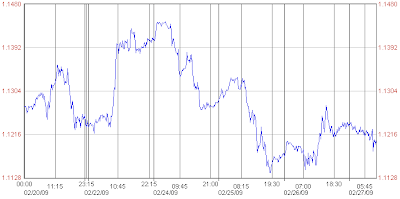 GBPEUR: 1 week chart. Click on graph to enlarge.
There are no major announcements due in the UK today, whilst the eurozone reveals their Consumer Price Index figures this morning, giving an indication of inflation at present.
 GBPEUR: 1 week chart. Click on graph to enlarge.
Little movement on cable
Sterling gained a little ground against the US dollar yesterday, helped by rising stock markets and the British government’s plan to insure against toxic assets for banks. The scheme, which is designed to remove uncertainties about the banks’ capital positions and enable them to focus on lending to customers again, could end up with the government insuring around £500bn in toxic assets held by UK banks. The news helped push shares higher, with the UK's FTSE 100 index rising by 2.2 percent, bolstering demand for riskier currencies such as the pound.
Data released in the US yesterday afternoon showed initial jobless claims reached a 26-year high, while sales of new homes fell 10.2% in January, to the lowest level since 1963. Figures also showed that durable goods orders were down 5.2% last month, and equity markets began to fall again following these releases, dragging the pound lower against the dollar.
There are several announcements taking place in the US today, including Gross Domestic Product and Real Personal Consumption Expenditures at 13.30 GMT. The dollar has continued to strengthen back over the pound this morning as investors are apprehensive about the release of this data.
 GBPUSD: 1 week chart. Click on graph to enlarge.
Data released in the US yesterday afternoon showed initial jobless claims reached a 26-year high, while sales of new homes fell 10.2% in January, to the lowest level since 1963. Figures also showed that durable goods orders were down 5.2% last month, and equity markets began to fall again following these releases, dragging the pound lower against the dollar.
There are several announcements taking place in the US today, including Gross Domestic Product and Real Personal Consumption Expenditures at 13.30 GMT. The dollar has continued to strengthen back over the pound this morning as investors are apprehensive about the release of this data.
 GBPUSD: 1 week chart. Click on graph to enlarge.
Poor US data ignored as risk aversion spreads
The euro strengthened over the dollar by 0.23 cents yesterday to close at 1.2741. Early in the session rising stocks in both Europe and the US fueled risk appetite and investors bought the euro. Later in the day however, new US Home Sales figures were announced and showed that there were 309,000 fewer sales in January than December, a fall of 10.2%. This reversed the performance of US stocks and the dollar pared it's gains as risk aversion returned. This was by no means the only major announcement yesterday though, the amount of Continuing Jobless Claims in the US rose to 5.112 million, Durable Goods Orders fell by 5.2% in January and 667,000 new Americans registered for unemployment benefits. However on all this negative news, the dollar failed to be weakened significantly which shows that exchange rates are not been derived off fundamentals.
In today's trading the dollar has strengthened back over the euro ahead of the announcement of Consumer Price Index data and Unemployment Rate data in the eurozone. In the US, GDP Annualized and Real Personal Consumption Expenditure are both announced as well as the Chicago Purchasing Managers' Index and the Reuters/Michigan Consumer Sentiment Index.
 EURUSD: 1 week chart. Click on graph to enlarge.
In today's trading the dollar has strengthened back over the euro ahead of the announcement of Consumer Price Index data and Unemployment Rate data in the eurozone. In the US, GDP Annualized and Real Personal Consumption Expenditure are both announced as well as the Chicago Purchasing Managers' Index and the Reuters/Michigan Consumer Sentiment Index.
 EURUSD: 1 week chart. Click on graph to enlarge.

Thursday, 26 February 2009
Pound weakens against euro on investor concerns
The pound continued its slide against the single currency yesterday as data showed the UK economy shrank an unrevised 1.5 percent in the last quarter of 2008, confirming the deep recession we are currently facing. Losses then steepened after the head of sovereign ratings at Standard & Poor's said he expected more downgrades than upgrades this year, removing the risk appetite in the market that had been apparent at the start of the week. Bank of England policymaker Kate Barker later said that British economic growth may not restart until the end of 2009.
Trading has been quiet so far this morning, following the release of Nationwide’s housing survey revealing a further 1.8% decline in house prices this month, bringing the annual rate of change to -17.6%. In the eurozone this morning consumer, economic and industrial confidence data is released, whilst there are no further economic announcements due in the UK today.
 GBPEUR: 1 week chart. Click on graph to enlarge.
Trading has been quiet so far this morning, following the release of Nationwide’s housing survey revealing a further 1.8% decline in house prices this month, bringing the annual rate of change to -17.6%. In the eurozone this morning consumer, economic and industrial confidence data is released, whilst there are no further economic announcements due in the UK today.
 GBPEUR: 1 week chart. Click on graph to enlarge.
Cable falls as economic outlook remains poor
Sterling fell sharply against the US dollar yesterday, losing more than 3 cents following GDP data which confirmed the UK economy shrank by an unrevised 1.5 percent in the last quarter of 2008, confirming Britain is in the midst of a deep recession. The dollar also gained support as investors sought its safe haven appeal following falls on Wall Street and more gloomy economic data. Data revealed US existing homes sales are at their lowest levels in almost 12 years, sparking fresh jitters about the economy and sending equities sharply lower.
The US dollar was also helped by the falling yen, amid growing concern about the Japanese recession. Usually the yen would be used as a safe haven currency during times of market volatility, but the current problems facing the Japanese economy have encouraged investors to move from the yen to the greenback.
There are no significant economic releases due from the UK today, while home sales, durable goods orders and jobless claims figures are released in the States this afternoon. President Obama will also be presenting his budget to Congress later today.
 GBPUSD: 1 week chart. Click on graph to enlarge.
The US dollar was also helped by the falling yen, amid growing concern about the Japanese recession. Usually the yen would be used as a safe haven currency during times of market volatility, but the current problems facing the Japanese economy have encouraged investors to move from the yen to the greenback.
There are no significant economic releases due from the UK today, while home sales, durable goods orders and jobless claims figures are released in the States this afternoon. President Obama will also be presenting his budget to Congress later today.
 GBPUSD: 1 week chart. Click on graph to enlarge.
Risk aversion sees dollar stregthen over euro
The dollar strengthened over the euro by 1.23 cents yesterday to close at the 1.2720 level, as risk aversion spread amongst investors and the dollar was heavily bought as a safe haven. An address by President Obama late on Tuesday did little to reveal how his administration planned to stabilise the economy. Figures released also showed that existing home sales fell by 5.3% in the US in January, which led to a fall in the price of stocks and promoted risk aversion. The euro's position was also undermined by news that Germany's economy contracted by 2.1% in the fourth quarter of 2008.
In today's trading the euro has come back as risk aversion abated after US stocks pared their losses in yesterday afternoon's trading. Also, German consumer confidence, as measured by Gfk, was shown to have improved this morning, and the rate at which German unemployment is increasing also slowed. Later today Consumer, Economic and Industrial Confidence data is released in the eurozone, whilst in the US, Durable Goods Orders, Initial Jobless Claims and New Home Sales figures are announced. Also taking place in the US today is the release of Barack Obama's budget report, which will give investors a clear indication about the future spending plans of his administration.
 EURUSD: 1 week chart. Click on graph to enlarge.
In today's trading the euro has come back as risk aversion abated after US stocks pared their losses in yesterday afternoon's trading. Also, German consumer confidence, as measured by Gfk, was shown to have improved this morning, and the rate at which German unemployment is increasing also slowed. Later today Consumer, Economic and Industrial Confidence data is released in the eurozone, whilst in the US, Durable Goods Orders, Initial Jobless Claims and New Home Sales figures are announced. Also taking place in the US today is the release of Barack Obama's budget report, which will give investors a clear indication about the future spending plans of his administration.
 EURUSD: 1 week chart. Click on graph to enlarge.

Subscribe to:
Posts (Atom)